Welcome back to school!
by Marvin Ramírez
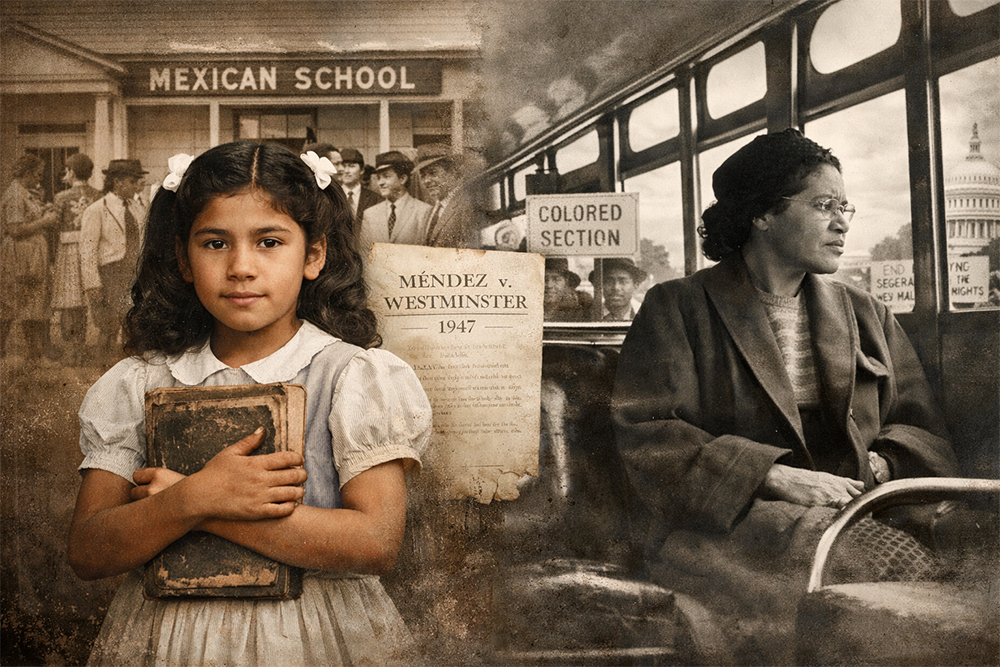
Before Rosa Parks refused to give up her seat.
Before Brown v. Board of Education ended school segregation nationwide.
An eight-year-old Mexican-American girl helped change the course of U.S. history.
Her name is Sylvia Méndez—and for decades, her story was pushed to the margins, minimized, or erased altogether. That erasure was not accidental. It reflected a long pattern in American history: honoring certain heroes while ignoring others, especially when those heroes were Latino.
In the 1940s, California operated a quietly racist system of public education. Thousands of Mexican-American children were systematically separated from their classmates and placed into so-called “Mexican schools.” Nearly 80 percent of children of Mexican heritage were diverted into these segregated classrooms—not because of academic performance, behavior, or intelligence, but because of assumptions rooted in prejudice.
These schools were predictably unequal. They were underfunded and overcrowded, stocked with outdated books and lacking basic supplies. In some cases, students did not even have proper desks or playgrounds. This was not education—it was exclusion disguised as policy.
The justification was never written into law. There was no statute requiring segregation of Mexican-American children. Instead, school officials relied on racism: darker skin, Spanish-sounding last names, or an English accent were enough to deny a child access to a decent education.
And then one family said no.
When Sylvia Méndez was just eight years old, her parents attempted to enroll her in the nearby public school in Westminster, California—the school reserved for white children. The response from administrators was blunt and unapologetic: only white children could attend.
There was no academic testing.
No evaluation of ability.
Just a closed door.
Sylvia’s father, Gonzalo Méndez, refused to accept that answer. Rather than walking away, he organized with four other Mexican-American families and filed a federal civil-rights lawsuit. It was a bold and risky move at a time when speaking out could cost you your job, your safety, or your future.
In court, school officials argued that Mexican children were “unclean,” “unprepared,” and unable to learn English. Those claims quickly fell apart when Mexican-American students themselves took the stand—speaking fluent, confident English and exposing the truth behind the discrimination.
On February 18, 1947, a federal judge ruled that segregating Mexican children violated the Constitution. The case, Méndez v. Westminster, made California the first state in the nation to end school segregation.
The decision sent shockwaves across the country. A young attorney named Thurgood Marshall submitted a brief supporting the Méndez family—years before he would argue Brown v. Board of Education before the U.S. Supreme Court. What began with one little girl helped lay the legal groundwork for the 1954 decision that ended school segregation nationwide.
And yet, for decades, Sylvia Méndez remained largely absent from the national conversation.
This omission matters.
Latinos—especially Mexican-Americans—have repeatedly been left out of the stories America tells about itself. They fought in World War I. They fought in World War II. They defended this nation abroad while facing discrimination at home. Yet when history is written, their contributions are too often minimized, delayed, or forgotten.
Sylvia Méndez was one of those forgotten heroes.
Only in 2011, more than six decades after her childhood courage reshaped American law, did the nation formally recognize her contribution. That year, President Barack Obama awarded her the Presidential Medal of Freedom, the highest civilian honor in the United States.
The recognition was deserved—but late.
Sylvia Méndez went on to live a full life as a nurse, a mother, and a lifelong advocate for education and equality. But her true legacy lives on in every classroom where children of different backgrounds sit side by side, learning together without being separated by skin color or ethnicity.
This is why her story still matters today.
And it matters especially now.
As this edition coincides with the first month of the school year, El Reportero sends a big hug to all the children who are starting—or continuing—their back-to-school journey. Every classroom they enter today, every desk they sit at, every lesson they share with children of all backgrounds exists, in part, because of Sylvia Méndez.
Thanks to her courage—and to the courage of families like hers—children today are able to learn together regardless of skin color, last name, or ethnicity. Her story is a reminder to every student that they belong in that classroom, that their presence matters, and that their future is worth defending.
At El Reportero, we remember Sylvia Méndez.
We remember her not as a footnote, but as a pioneer. Remembering her is an act of truth. Forgetting her was an act of convenience.
This is American history.
This is Mexican-American history.
And it belongs to all of us.