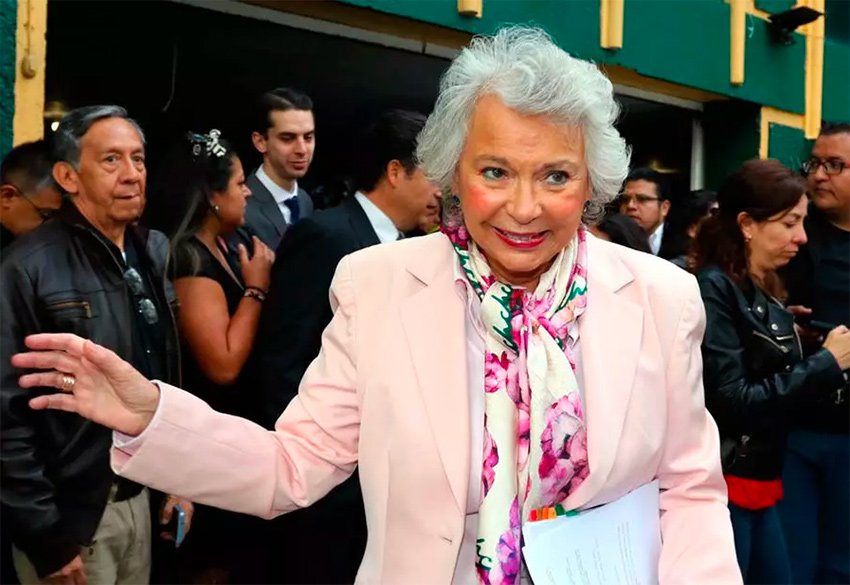
Current administration analyzing US proposal to provide $20 million to deport Central American migrants
by Mexico News Daily
The incoming federal government will not accept funding from the United States to “police” and deport migrants, the prospective interior secretary said.
Asked about a September 12 report in The New York Times, which said that the administration of United States President Donald Trump intends to offer Mexico US $20 million to help pay for plane and bus fares to deport as many as 17,000 Central American migrants before they reach the U.S., Olga Sánchez Cordero said that no such proposal had been made.
“Mexico would never lend itself to being police for the United States?” a reporter asked the former Supreme Court judge.
“That has not been put on the table in any way,” Sánchez Cordero said.
“And you wouldn’t do it?”
“No, definitely not,” the future interior secretary responded.
However, the current government, which has less than three months left in office, said in a statement issued by the Secretariats of the Interior and Foreign Affairs that it is “continuing to evaluate the proposal” from the Trump administration, which The Times said was outlined in a note sent to the U.S. Congress.
But the statement stressed that “the government of Mexico has not accepted verbally or in written form said proposal, nor has it signed any document in this respect.”
It added that the government will continue to cooperate with the United States on migration, “seeking at all times . . . to promote orderly, legal and safe migration with full respect to human rights and the international legal framework.”
Sánchez Cordero said that president-elect Andrés Manuel López Obrador’s proposal for migration is clear and involves collaborating with Central American countries to stimulate economic and social development.
Under the plan, the necessity for citizens of countries such as Honduras, Guatemala and El Salvador to make the often-perilous journey through Mexico to the United States would be reduced.
“What Andrés Manuel wants is for people to emigrate to the United States out of preference not necessity,” Sánchez Cordero said.
In a letter sent to Trump in July, the president-elect proposed that Mexico, the United States and each Central American nation contribute resources according to the size of its economy and that 75 percent of the collective funds be allocated to finance projects that create jobs and combat poverty, while the other 25 percent would go to border control and security.
“At the same time, every government, from Panama to the Rio Grande, would work to make the migration of its citizens economically unnecessary and take care of their borders to avoid the illegal transit of merchandise, weapons and drug trafficking which, we believe, would be the most humane and effective way to guarantee peace, tranquility, and security for our peoples and nations,” he wrote.
The revelation that the Trump administration is proposing to pay its southern neighbor to help curtail migration flows contrasts sharply with the U.S. president’s repeated promises that Mexico will pay for his proposed border wall.
Although Mexico detains thousands of migrants every year, Trump has repeatedly portrayed the Mexican government as a poor ally on migration issues.
“Mexico does nothing for us,” he said in May.
“Mexico talks but they do nothing for us, especially at the border. They certainly don’t help us much on trade, but especially at the border they do nothing for us,” Trump declared.
A spokeswoman for the U.S. Department of Homeland Security said the government’s funding proposal, which would redirect foreign aid money, was aimed at relieving immigration flows across the Mexico-United States border.
“We are working closely with our Mexican counterparts to confront rising border apprehension numbers — specifically, a 38% increase in families this month alone — directly and to ensure that those with legitimate claims have access to appropriate protections,” Katie Waldman said.
While the relationship between Trump and López Obrador appears to have got off to a good start, getting the latter to agree to the former’s deportation plan would require a significant turnaround.
On the campaign trail leading up to the July 1 election, the then-candidate pledged that Mexico “wouldn’t do the dirty work” of foreign governments, referring specifically to the deportations of Central Americans.
Source: Milenio (sp), Dinero en Imagen (sp), El Universal (sp)
Walmart to acquire food delivery service Cornershop
Company seeks to increase its online grocery business
Retail giant Walmart will acquire Latin American food delivery service Cornershop for US $225 million, the company said this week, in a move aimed at increasing its online grocery business in Mexico and Chile.
Shares of the company’s Mexican subsidiary known as Walmex spiked more than 3% on the news to close at their highest level since late July.
The acquisition of Cornershop, whose mobile application allows shoppers to select grocery items from several participating supermarkets, is part of Walmart’s broader global strategy to invest in online delivery services as it aims to compete with Amazon, the world’s largest online retailer.
Analysts say the purchase will help the United States-based retailer to quicken deliveries in Mexico from its Walmart, Superama and Sam’s Club stores.
“We believe the transaction is positive and will result in greater efficiencies and higher growth in online sales,” financial analysis company Signum Research said in a report.
According to market research firm Euromonitor International, just 3% of all retail sales in Mexico are online but traditional retailers are investing in logistics and technology to meet the growing demand for e-commerce.
Amazon México last month expanded its inventory to include food and beverages, including snacks, sweets, coffees and teas and wine and liquor, increasing the options for online shopping in Mexico.
Walmart said that it anticipates closing the Cornershop deal by the end of this year, adding that the application will continue to be an “open platform” that allows supermarkets owned by other companies to partner with it.
Mexican grocery chains Chedraui and La Comer as well as U.S.-based retailer Costco all offer deliveries via the app but declined to comment on Walmart’s acquisition.
Walmart International CEO Judith McKenna said the Cornershop deal would provide a learning experience for the company’s other markets.
Walmart México opened 79 new stores last year under a range of its brands and last month announced that it is moving into the automotive retail fuel market in four Mexican states.
Source: Reuters (en)