by the El Reportero wire services
Mexico has agreed to avoid incurring new deficits in water delivery to the U.S. as part of a new commitment to adhere to the terms of the 1944 Water Treaty.
In a Tuesday social media post, the Agriculture Ministry (Sader) said the agreement “establishes a clear path in accordance with the mechanisms provided for in the Treaty and is the result of sustained technical and political work.”
It said the plan was negotiated with “full respect for the sovereignty of both countries, while ensuring at all times the human right to water and food for communities in our country.”
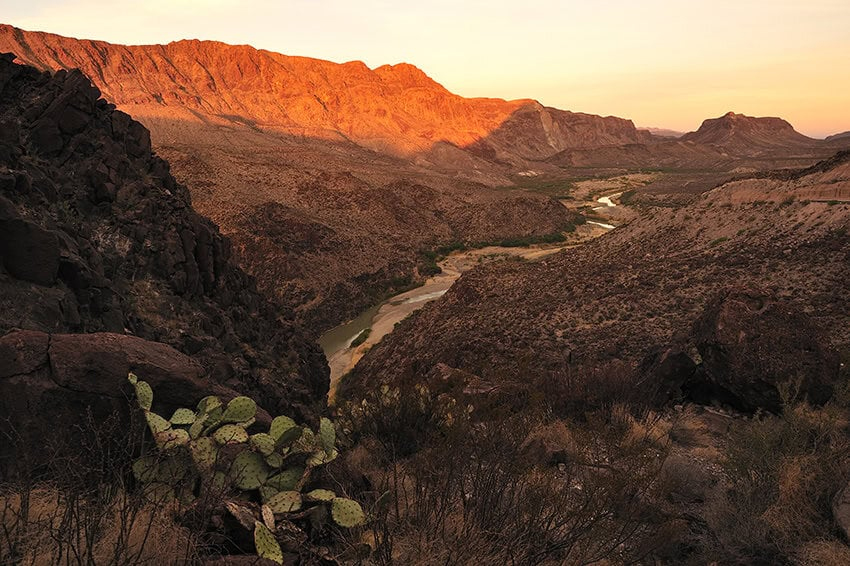
This week’s announcement comes after President Claudia Sheinbaum and U.S. President Donald Trump discussed how to resolve long-standing challenges in the management of water in the Río Bravo basin (called Rio Grande in the U.S.) in a Jan. 29 phone call.
In recent years, Mexico has struggled to make the required water deliveries, citing drought conditions fueled by climate change and local demand, a challenge Sheinbaum reiterated during her Friday morning press briefing.
This latest agreement comes hard on the heels of December negotiations that sought to stave off a threat of tariffs, since Mexico still owed the U.S. just over 865,000 acre-feet of water when the 2020-2025 cycle of the treaty ended in October.
At the time, the U.S. Trump administration blamed Mexico’s missed water deliveries for major crop losses for Texas farmers.
For its part, the U.S. Department of Agriculture (USDA) said on Tuesday that the new commitment will “provide greater certainty for farmers, ranchers and producers in South Texas who rely on consistent water deliveries from the Rio Grande.”
In a joint statement with the Foreign Relations Ministry, the Environment Ministry and the National Water Commission, Sader confirmed Mexico’s willingness “to guarantee the delivery of a minimum annual amount agreed between both countries, according to the hydrological conditions of the basin and the mechanisms provided for in the Treaty.”
The agreement accounts for the supply for both human consumption and agricultural production, while also “strengthening the orderly management of water resources in the Rio Grande basin and moving towards more predictable planning and shared responsibility in the face of the effects of drought, incorporating infrastructure and long-term adaptation actions.”
In the joint statement, Mexico reaffirmed its commitment to the water treaty, describing it as “an instrument that safeguards national interests, as well as the protection of productive and agricultural activities in national territory.”
Mexico has agreed to deliver a minimum of 350,000 acre‑feet of water per year to the U.S. during the current five‑year cycle and will formulate a detailed plan to fully repay all outstanding water debt accrued during the previous cycle.
Additionally, both parties will hold monthly meetings to ensure timely, consistent deliveries and prevent future deficits, the USDA statement said, adding that the U.S. State Department and other federal partners will work closely to ensure satisfactory implementation.
U.S. Agriculture Secretary Brooke Rollins said that in the event of future non-compliance, the U.S. reserves the right to impose trade measures, including the application of tariffs.
With reports from Proceso, El Economista and Reuters
In other news from Mexico:
4 US Air Force aircraft make emergency landing on the Baja Peninsula
The Defense Ministry (Sedena) on Thursday acknowledged that it had authorized overflight and emergency landings for four U.S. aircraft that landed that day in Mexican territory.
The U.S. Air Force aircraft involved in Thursday’s incident were two Hercules tanker aircraft for in-flight refueling and two HH-60W helicopters.
In a social media post, Sedena said it “authorized the overflight in national airspace of two Hercules tanker aircraft and two helicopters from the U.S. Air Force, which were taking part in the rescue of a patient from a vessel at sea 400 nautical miles west of [the Baja Peninsula].”
No details were provided regarding where the planes landed, how long they were within Mexican airspace or for how much time they remained on the ground.
This incident comes a little more than two weeks after the landing of a U.S. Air Force plane in Toluca, just 65 kilometers (40 miles) west of Mexico City. It was allegedly linked to training activities that had not been previously reported publicly, and generated some controversy.
At the time, President Claudia Sheinbaum stated that the entry of U.S. military aircraft into the country would only be authorized under “special conditions.”
Days earlier, the U.S. Federal Aviation Administration urged U.S. aircraft operators to “exercise caution” when flying over the eastern Pacific Ocean near Mexico, Central America and parts of South America, citing “military activities.”
In response, Sheinbaum sought to quell concerns related to the two incidents, saying that the U.S. “wasn’t conducting any military activity in national territory.”
In an official bulletin issued on Thursday, Sedena said that the authorization was granted “in accordance with the Coordination Guidelines for Authorizing Overflights in Mexican Airspace and Landing of Foreign Aircraft.”
Sedena also reaffirmed its “commitment to international cooperation to safeguard the lives of people and regional security,” while citing the principles of “reciprocity, shared and differentiated responsibility, mutual trust and respect for sovereign decisions and territories.”
Authorization for overflights and landings in Mexican airspace must strictly adhere to Federal Civil Aviation Agency regulations, which generally require obtaining permits 48 hours in advance.
With reports from El Universal, Milenio, Sin Embargo and Nación321