by Marvin Ramírez
What happened over the span of a single week barely registered as a headline, yet it may come to define the geopolitical logic of this era. Without speeches, without congressional theater, without the drumroll of cable news, Donald Trump upended a long-standing enmity and replaced it with something far more unsettling: leverage. Not friendship. Not peace. Control.
The debate that followed, predictably loud and predictably shallow, fixated on familiar talking points. Drugs. Terrorism. Oil. Critics accused Trump of hypocrisy—of invading a sovereign nation after vowing never to start a war. Supporters framed it as muscular leadership. Both camps, however, largely missed what was actually unfolding.
This was never about Venezuela in isolation. And it certainly wasn’t about America’s need for oil.
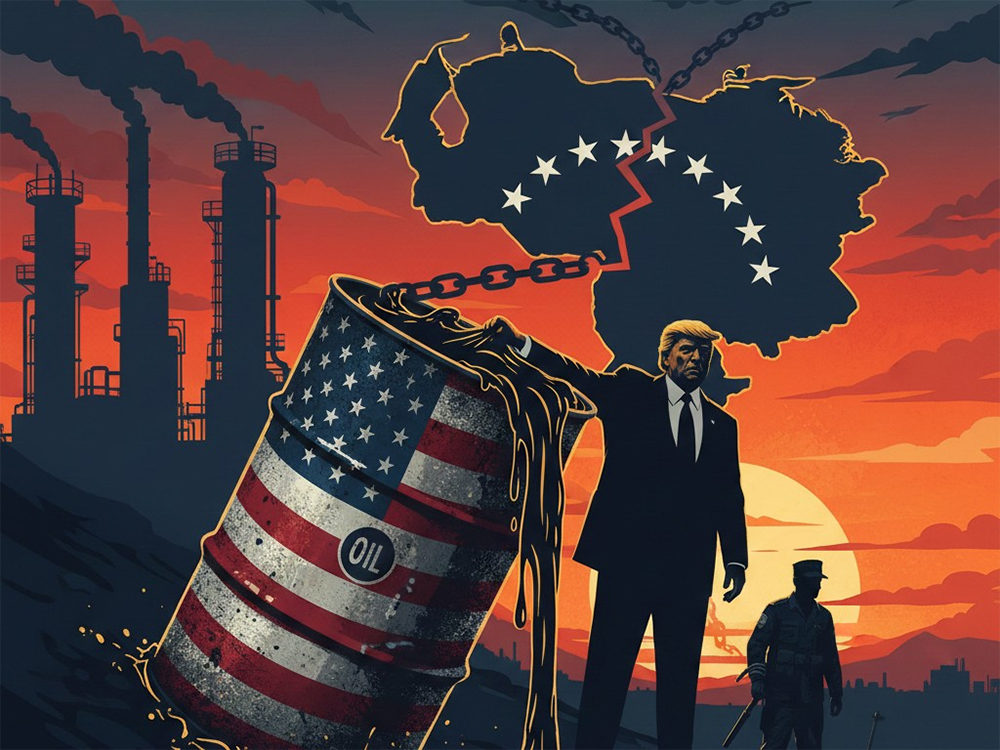
Venezuela sits atop the largest proven oil reserves on Earth—more than 300 billion barrels, worth trillions of dollars at market prices. That fact alone invites confusion. Why would the United States, now one of the world’s top energy producers, risk global backlash over oil it doesn’t even need?
The answer is simple, and far more uncomfortable: the oil doesn’t matter because America isn’t the customer.
China is.
Beijing absorbs the overwhelming majority of Venezuela’s crude, just as it relies heavily on oil from Iran and Russia. Together, these suppliers form the backbone of China’s energy security outside U.S.-regulated markets. Strip that supply away, and China doesn’t just lose fuel—it loses momentum. Industrial capacity slows. Strategic flexibility shrinks. Ambitions narrow.
Energy is the bloodstream of modern power. No energy means no sustained military operations. No energy means no massive AI infrastructure. No energy means no alternative global currency strong enough to challenge the dollar. Wars are not only fought with missiles and tanks; they are fought with logistics, electricity, and fuel.
Trump understood something many policymakers prefer not to say out loud: dominance in the 21st century doesn’t come from owning resources. It comes from deciding who gets access to them.
By destabilizing Venezuela and tightening pressure on Iran, the United States didn’t fire a shot at China, yet suddenly threatened to choke off a massive share of its unregulated oil supply. The implications are profound. A Taiwan conflict becomes exponentially harder to sustain. Long-term technological supremacy becomes more expensive. The vision of a post-dollar global order weakens.
And all of it happens without a formal declaration of war.
This is what makes people uneasy. There is no dramatic battlefield to point to, no clear moment of escalation, no vote to condemn. Just quiet pressure applied at precisely the right points in the global system. To some, this feels reckless. To others, immoral. But to dismiss it as chaos is to misunderstand it entirely.
What looks like improvisation is, in fact, alignment. Old enemies become temporary partners. Long-standing assumptions are discarded. Ideological purity gives way to transactional reality. In this framework, alliances are not sacred—they are useful.
That is why the familiar moral language fails here. This is not about whether Trump is polite, consistent, or even likable. It is about whether he recognizes where real power resides. In this case, he did. He recognized that energy flows shape empires, and that controlling those flows can achieve outcomes armies alone cannot.
No permission was requested. No consensus was built. That, too, was the point.
History will decide whether this approach stabilizes the world or accelerates its fractures. But one thing is already clear: this was not an accident, and it was not a gamble. It was a deliberate move in a long game—one where the loudest arguments are distractions, and the real contest happens quietly, behind the scenes, where leverage matters more than applause.
– With reports by Atlas World News.