by México Desconocido
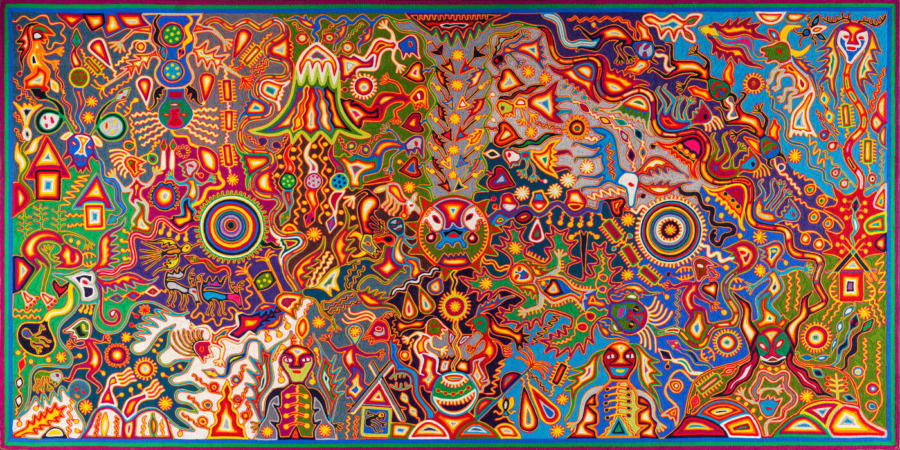
José Benítez’s Nierika Wixárika table is a sacred work that reveals myths, deities, and symbols of the Huichol spiritual universe.
The Nierika Wixárika table created by José Benítez is not only a piece of art, but also a sacred portal, a visual narrative that unravels the complex cosmogony of the Huichol people. Those who pause to look at it calmly discover that they are looking at a map of the universe: a divine face, an ancestral territory, and a mystical vision all in one.
This yarn mosaic, entitled The Vision of Tatutsi Xuweri Timaiweme, is considered one of the most complete and powerful works of contemporary Indigenous art. Through vibrant colors and enigmatic forms, Benítez captured a living story inhabited by deities, myths, and symbols that explain the origin of the world according to Wixárika tradition.
What is a Wixárika nierika tabla?
Wixárika art has distinguished itself by depicting the invisible. Nierika tabla—whose name means instrument for seeing—are visual pieces that allow us to look beyond the apparent. Originally, they were small ritual objects used by mara’akate (shamans) to connect with the gods and their ancestors during ceremonial journeys.
Over time, this tradition evolved into larger, more narrative formats. Using colored yarn bonded with wax on wooden surfaces, artists began to construct complex scenes: cosmogonic stories, sacred maps, and portrayals of visions obtained with peyote. José Benítez took this tradition to the limit, and his most famous work is proof of this.
José Benítez: Artist Who Saw with the Eyes of the Spirit
Yukaiye Benítez Sánchez, also known as José Benítez, was born in 1938 in Wautia, Jalisco. From a young age, he felt the calling to become a mara’akame, the spiritual guide of his community. His mission was not only to learn traditional songs and rituals, but also to capture the visions of his ancestors in images.
Benítez wasn’t content with repeating patterns: he transformed the Wixárika nierika panel into a language of his own. His narrative style, sometimes abstract and sometimes saturated with symbols, made him one of the greatest exponents of 20th-century Huichol art. For him, every stroke had meaning, every color contained a message. His art was not decoration, but a form of knowledge.
The Wixárika nierika panel, a representation of the indigenous worldview
Tatutsi Xuweri Timaiweme’s vision, created in 1980, measures more than two meters wide. On that surface, Benítez integrated thirteen deities, nine founding myths, and nine sacred symbols. It is a complex work that requires time and patience to understand. The protagonist is Tatutsi Xuweri Timaiweme, Our Great-Grandfather, an ancestral figure who embodies the divine worldview. Also featured are Tayau (the Sun), Tatewari (Fire), Tatei Yurianaka (the Earth), the Blue Deer, and peyote, among other central elements of Wixárika thought.
The tablet simultaneously represents an illuminated face, a constellation of gods, and a territory charged with spiritual energy. Its lines intertwine mythical time, the ceremonial present, and the cycles of nature. It is a work that begs to be read as if it were a modern codex: each figure reveals something, but also holds a secret.
Speaking Symbols: Arrows, Snakes, and the Blue Deer
Within Benítez’s nierika Wixárika tablet, essential figures for the Huichol people’s worldview are repeated. The arrows, for example, represent prayers offered to the spiritual world. The snakes embody the power of underground rivers and the energy of transformation. The deer, a sacred guide, symbolizes communication with the gods.
Another key element is the nierika itself, represented as a disc or a rhombus. This symbol refers to the vision acquired through peyote and the ability to see the hidden. It is no coincidence that the entire panel is constructed as a gigantic nierika: contemplating it, one enters the very vision of the artist and his tradition.
A preserved legacy
Benítez’s panel was safeguarded by anthropologist Juan Negrín and later donated to the National Museum of Anthropology, where it now forms part of the INAH collection. Although it began as a spiritual revelation, today it is also a heritage work that preserves the voice of a people.
Through it, visitors can gain a glimpse into the way the Wixaritari explain the world: not with academic words, but with sacred images. The painting is a testament to a living legacy, one that continues to beat in the altars, in pilgrimages, in the songs, and in the visual memory that artists like Benítez left behind.