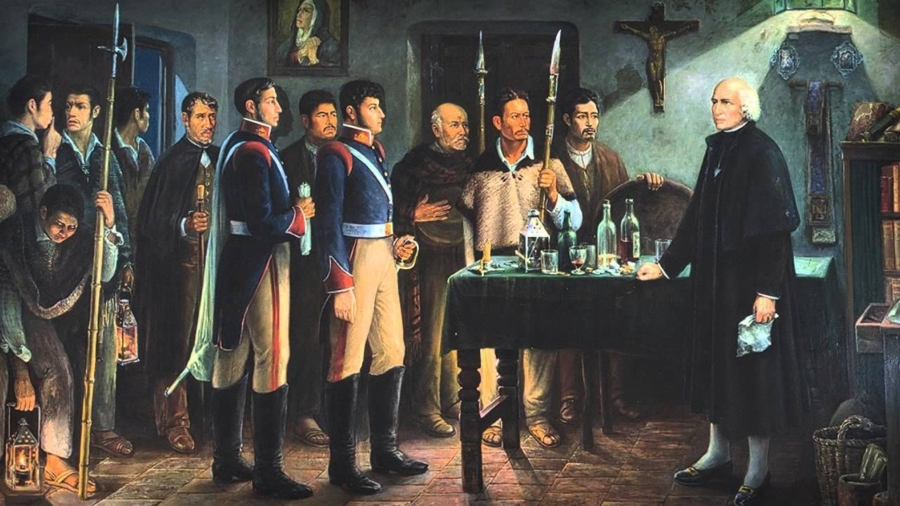
Ignacio Allende was a key leader in the Mexican Independence. Discover his most significant actions and why he is one of the founding fathers.
by El Reportero news services
Every September, a question arises that sparks debate: Was Ignacio Allende the true Father of the Nation? Official history grants that title to Miguel Hidalgo, but the truth is that Ignacio Allende’s role in the Mexican Independence was so decisive that he is also recognized as one of the nation’s fundamental heroes.
Ignacio Allende in the Independence Plot
Ignacio Allende, born on January 21, 1769, in San Miguel el Grande (today San Miguel de Allende, Guanajuato), was a captain in the Queen’s Dragoon Regiment. His military experience gave him a central role in the secret meetings in Querétaro, where, along with Miguel Hidalgo, Juan Aldama, and Josefa Ortiz de Domínguez, he organized the uprising against the Spanish Crown.
Allende was one of the main liaisons between civilians and the military within the conspiracy. His strategic skill helped lay the foundations for the independence movement that would erupt in 1810.
Allende’s Role in the Beginning of Mexico’s Independence
Although it was Hidalgo who delivered the famous Grito de Dolores, Allende played a decisive role in the beginning of the War of Independence. He led insurgent troops and, thanks to his military training, became the tactical mastermind behind several battles.
He was present at the capture of the Alhóndiga de Granaditas and at the Battle of Monte de las Cruces, where the insurgent army achieved one of its most resounding victories. His discipline contrasted with Hidalgo’s more improvisational style, which generated tensions between the two leaders, but also reflected the diversity of perspectives within the movement.
Strategist of the Insurgent Movement
Allende believed in the need to transform the insurgency into a formal army. He sought to organize troops with discipline and hierarchy, convinced that improvisation could cost them the cause.
This military vision was key to giving continuity to the movement after its initial successes and failures. Although differences with Hidalgo led him to distance himself at times, the combined leadership of both parties proved essential to sustaining the struggle.
Capture of Ignacio Allende, leader of the Mexican Independence
In 1811, after the defeat at Puente de Calderón, Allende, Hidalgo, and other insurgents began their retreat north. However, they were betrayed and captured in Acatita de Baján.
Allende was taken to Chihuahua, where he was shot on June 26 of that same year. His death, far from extinguishing the movement, strengthened the spirit of those who continued the fight for independence.
Today, Allende is remembered as one of the great leaders of the Independence. His military vision, his courage in battle, and his conviction place him among the undisputed protagonists of national history.
Determining whether or not he was the true Father of the Nation is less important than recognizing that, along with Hidalgo and other insurgents, Allende laid the foundations for Mexican freedom. Every September, his name resonates as an essential part of that chorus of voices that shaped independent Mexico.
– With reports from México Desconocido.