by Marvin Ramírez
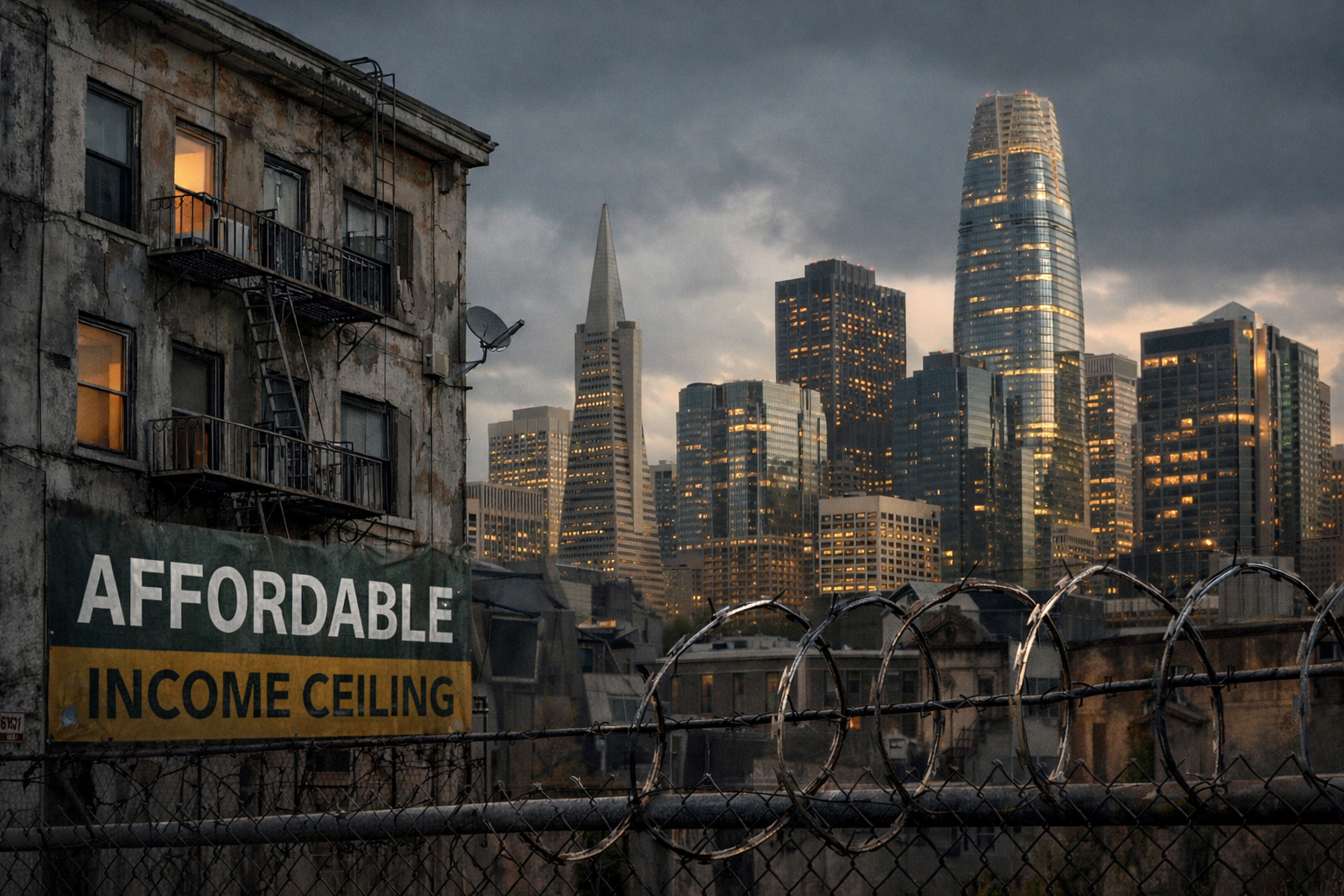
San Francisco has become a city where survival is subsidized, but progress is quietly punished. For years, city and county governments have promoted housing developments aimed at low-income residents as the primary response to the affordability crisis. These buildings are not constructed by government agencies themselves. They are built by private developers—but under conditions dictated by cities through zoning rules, planning approvals, and building permits.
In exchange for the right to build, developers are required to include below-market-rate apartment units. The logic is straightforward: use private development to produce housing that people with limited incomes can afford. For families with no other options, these units offer stability in one of the most expensive cities in the country.
But stability alone is not enough. What is missing from this model is a future.
In San Francisco, income-restricted housing comes with strict ceilings. Tenants must recertify their income once or twice a year. Earn too little, and you struggle to survive. Earn slightly more, and you risk losing your home. A raise, overtime hours, or a second job can suddenly turn into a liability. Advancement becomes dangerous. Ambition is punished.
This system may prevent homelessness, but it does not create mobility. It freezes families at a specific economic level and quietly discourages progress. Affordable housing, as it is currently structured, functions less like a bridge and more like a permanent holding zone—one where residents are allowed to stay only if they remain poor enough to qualify.
That reality took on new urgency after Donald Trump announced that he plans to ban large institutional investors from buying single-family homes. The proposal has sparked predictable political reactions, but its underlying premise reflects a reality many families already experience. When corporate investors enter the housing market with cash offers and the ability to pay above market price, ordinary buyers are pushed out.
Across California and much of the country, institutional investors and large corporations have reshaped the single-family housing market. By paying above asking price, waiving contingencies, and moving faster than families who rely on mortgages, they reset property values and drive prices higher. Entire neighborhoods become more expensive overnight—not because wages increased or communities prospered, but because speculation did.
The consequences are profound. Teachers, city workers, health-care employees, and small-business owners—people who once could reasonably aspire to buy modest homes—are now permanent renters. In San Francisco, the dream of owning a home has faded so completely that it is barely mentioned in housing policy discussions. The focus has shifted almost entirely to rental supply, not ownership opportunity.
At the same time, cities continue approving large-scale rental developments with mandated below-market units. These projects help local governments meet housing targets and satisfy state requirements, but they do nothing to address the disappearance of ownership as a realistic goal for working families. The assumption seems to be that some residents will always rent—and that this condition is acceptable, even permanent.
It should not be.
Those who qualify for below-market apartment units should be given the opportunity to become owners of those units. This is not a radical idea; it is a logical and humane one. Tenants who consistently pay rent, maintain their homes, and demonstrate financial responsibility should be offered clear, structured pathways to ownership. This could include rent-to-own programs, shared-equity models, limited-equity cooperatives, or gradual buy-in systems supported by public agencies.
Ownership is how wealth is built in this country. It is how families create stability and pass opportunity to their children. Without ownership, affordable housing becomes a mechanism for managing poverty rather than ending it. Generations remain locked into renting, with nothing to inherit but uncertainty.
San Francisco’s current model does the opposite of what it claims to achieve. A family that improves its income is not rewarded with greater security; it is threatened with displacement. There is no graduation process, no equity accumulation, no acknowledgment that progress should be encouraged rather than feared. The safety net disappears the moment it should evolve into a ladder.
This outcome is not inevitable. It is the result of policy choices. Cities control zoning, permits, and affordability requirements. They have the power to require not only below-market units, but also ownership pathways. They can insist that housing developments include mechanisms for residents to build equity and eventually own where they live.
Meanwhile, corporate consolidation of single-family homes continues largely unchecked. Cities regulate the poor with precision—monitoring income limits and recertifications—while hesitating to confront concentrated wealth at the top of the housing market. Between those two forces, the middle class is slowly erased.
Trump’s proposal to restrict institutional investors may or may not become law. But it forces an overdue conversation about who housing is really for. Homes should not exist solely as financial instruments. They are the foundation of families, neighborhoods, and long-term community stability.
Affordable housing must remain part of the solution. But it cannot be the final destination. If the true goal is to lift people out of poverty, housing policy must allow people to own, to build wealth, and to leave something behind for the next generation.
A city that only allows people to survive is not a city that believes in opportunity. San Francisco can—and should—build a housing system that offers not just shelter, but a future.