by Steven Mosher
The Trump administration is not discarding Christian values in the international arena or anywhere else. It is putting them into practice.
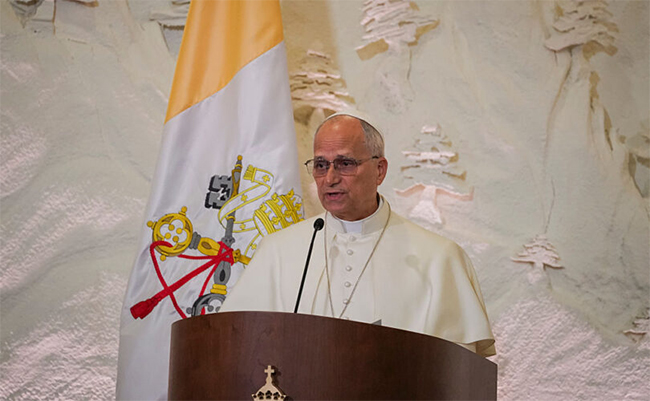
Pope Leo XIV’s Catholic perspective on international relations, communicated in his January 9 “State of the World” address to foreign ambassadors accredited to the Holy See, has been widely interpreted as an implicit critique of the so-called “Donroe Doctrine.” In pursuing hemispheric security, the Pope suggested, the United States should not abandon its historic commitment to democratic ideals and human rights abroad. These higher values, rooted in the spiritual insights of St. Augustine’s City of God, must never be set aside in global affairs.
Three American cardinals—Cupich, McElroy, and Tobin—have echoed this concern, criticizing President Trump’s foreign policy for retreating from multilateralism and globalism. They argue this shift weakens America’s moral role in confronting evil worldwide. Such claims, however, reflect a misunderstanding of both American history and current policy.
From its earliest days, the United States has upheld democratic principles, religious liberty, and human rights. The Constitution, crafted by Christian founders, remains the greatest governing document ever produced. Its Bill of Rights established freedoms of speech, religion, press, assembly, and due process that became the foundation of modern human rights. As America marks 250 years of independence, it is worth remembering how profoundly this model of ordered liberty has influenced the world.
Roughly 160 of the world’s 170 constitutions draw, at least in part, from the U.S. model. By its very existence, the United States promotes democratic values and human dignity. America’s role as a beacon of freedom does not depend on military imposition but on faithful practice at home. Free elections, peaceful transitions of power, secure borders, safe streets, and equal opportunity do more to advance human rights than any foreign intervention.
When America lives its principles, others seek to emulate them. The collapse of communism in Eastern Europe illustrates this truth. President Reagan challenged tyranny rhetorically, but it was the people themselves who dismantled the Berlin Wall and dissolved the Soviet Union. Today, similar aspirations for freedom are heard in Venezuela and Iran, inspired by the American example.
Attempts to export democracy by force, as seen in Iraq and Afghanistan, have failed. Democratic systems can only take root where populations share the underlying beliefs that sustain them. They cannot be imposed on societies fundamentally opposed to their principles.
Pope Leo lamented the decline of multilateralism, arguing that the post–World War II framework designed to prevent nations from violating borders has eroded. Yet that framework emerged from the United Nations, an idealistic but ultimately flawed institution. The U.N. has proven incapable of preventing conflict or protecting human rights, with its Human Rights Council often dominated by the world’s worst offenders.
The Trump administration’s National Security Strategy recognizes this failure. Unilateral action has replaced ineffective multilateralism, and notably, without firing a shot, Trump has ended eight conflicts that might have escalated into wider wars. This approach is not hegemonic. The “Donroe Doctrine” does not seek American dominance but protection of the United States and its neighbors from genuine threats, particularly China’s global ambitions.
In this, President Trump aligns closely with President James Monroe. The Monroe Doctrine was never about controlling Latin America. It warned European powers against recolonization or interference, asserting that such actions would be viewed as hostile. Then and now, the goal has been to prevent external domination of the hemisphere, not to impose American rule.
Venezuela under Nicolás Maduro illustrates this principle. The regime, aligned with China, brutalized its people and endangered Americans. Removing Maduro creates the possibility for democracy, human rights, and religious freedom. Few doubt that America’s ultimate aim is to respect the will of the Venezuelan people and secure a stable, free future.
The Trump administration is not abandoning the Christian virtues articulated by St. Augustine 1,600 years ago. It is applying them prudently in a dangerous world. That is the American way.
(Steven Mosher is the president of the Population Research Institute and an internationally recognized authority on China and population issues. He was the first American social scientist allowed to conduct fieldwork in communist China (1979-1980), where he witnessed forced abortions and sterilizations of women under the new one-child policy.)
– This article was cut to fit space.