by the El Reportero staff writer
For Latino communities in California, 2025 was a year shaped by heightened political activity, legal battles, and civic engagement. Immigration enforcement, voting power, and legislative responses dominated headlines, while community organizations and elected officials worked to address uncertainty and change. As the year closes, several moments stand out for their lasting political and social impact on Latinos across the state.
- Immigration enforcement intensifies across California
Immigration policy returned to the forefront of national debate in 2025, following the start of President Donald Trump’s second term. The administration renewed its focus on immigration enforcement, pledging to increase deportations and tighten border controls. While federal officials reported more than 500,000 removals nationwide, independent estimates from the Migration Policy Institute placed the number closer to 340,000 by September.
California, home to the nation’s largest Latino population, saw increased enforcement activity in several regions. Immigration and Customs Enforcement (ICE) operations were reported in urban and rural areas alike, including Los Angeles, the Central Valley, and parts of the Bay Area. Agents conducted arrests near workplaces, public facilities, and residential neighborhoods, prompting concern among immigrant families.
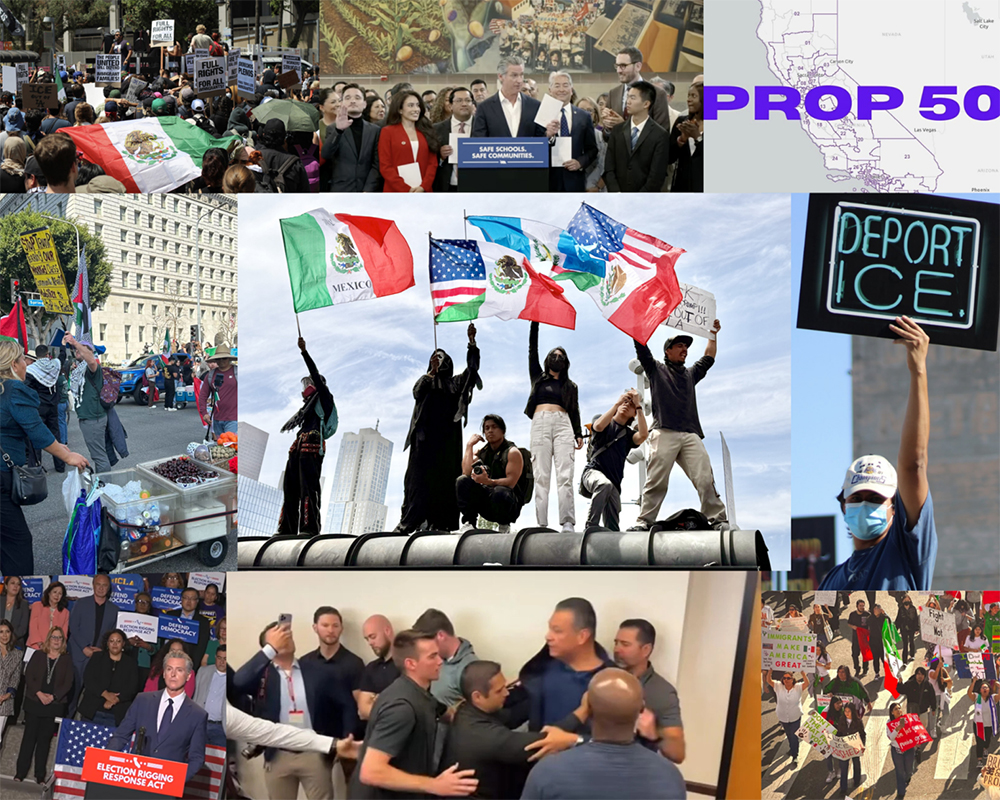
In June, enforcement activity in Los Angeles coincided with large public demonstrations. Thousands gathered downtown to protest federal actions, leading to heightened security measures and crowd control by law enforcement. President Trump described some demonstrations as disorderly and authorized the deployment of National Guard units to assist with security operations, a move that state officials disputed and later challenged in court.
Supporters of the administration argued that enforcement efforts were necessary to uphold federal law, while critics raised concerns about civil liberties and community trust. Regardless of perspective, the increased visibility of immigration enforcement had a significant impact on daily life in many Latino neighborhoods.
- Latino voters play decisive role in Proposition 50
Despite concerns surrounding immigration enforcement, Latino voters demonstrated their political influence at the ballot box. Proposition 50, a redistricting measure placed on the statewide ballot, passed with strong Latino support. Exit polling showed that approximately 71 percent of Latino voters supported the initiative.
The measure was promoted by supporters as a safeguard against partisan gerrymandering and a way to preserve competitive districts ahead of the 2026 midterm elections. Both Democratic and Republican campaigns invested heavily in outreach to Latino voters, recognizing their growing share of the electorate, which now approaches one-third of California voters.
High-profile figures appeared in campaign advertising, and Spanish-language media played a central role in voter education. Following the election, California Republicans filed a lawsuit challenging the new district maps, arguing they improperly considered race in drawing boundaries. The case is expected to move through the courts in 2026.
The vote reinforced a broader national trend: Latino voters are increasingly pivotal in shaping electoral outcomes, not only in California but across several battleground states.
- State and local governments pass law enforcement transparency measures
In response to concerns about immigration enforcement practices, California lawmakers passed two notable bills in 2025: Senate Bill 627 and Senate Bill 805. Together, the measures aim to increase transparency among law enforcement officers operating within the state.
SB 627, known as the No Secret Police Act, prohibits officers from covering their faces while performing official duties. SB 805, the No Vigilantes Act, requires visible identification for law enforcement personnel. Supporters argued that the measures were designed to reduce confusion, prevent impersonation, and strengthen public trust.
The U.S. Department of Justice challenged both laws, asserting that they interfere with federal authority and violate the Supremacy Clause of the Constitution. Legal proceedings are ongoing.
At the local level, the Los Angeles City Council approved a similar ordinance in December, set to take effect in January 2026. While the measure passed, some officials expressed concerns about its legal standing and potential conflicts with federal operations.
- Family Preparedness Act expands protections for immigrant households
California lawmakers also focused on policies aimed at reducing disruption to families affected by detention or deportation. Assembly Bill 495, the Family Preparedness Act, was introduced by Assemblymember Celeste Rodriguez and signed into law in October.
The legislation expands the list of relatives eligible to serve as temporary guardians for children if parents are detained. It also requires schools and child care providers to offer guidance to families on emergency preparedness related to family separation.
Advocates said the law offers families greater stability during uncertain times, while critics questioned whether the state was overstepping its role. Nonetheless, the bill reflects California’s continued effort to address the social consequences of federal immigration enforcement.
- DHS confrontation involving Sen. Alex Padilla draws national attention
One of the most widely covered incidents of the year occurred during a Department of Homeland Security press conference in Los Angeles. Sen. Alex Padilla, who was present at the Wilshire Federal Building, attempted to question DHS Secretary Kristi Noem regarding enforcement policies.
Federal agents escorted Padilla out of the room, and a physical confrontation followed in a hallway, where the senator was briefly restrained. Video of the incident circulated widely, prompting responses from lawmakers across the political spectrum.
Padilla later said the incident raised broader concerns about transparency and accountability. DHS officials stated that security protocols were followed. The episode sparked debate about access, authority, and conduct during high-profile federal events.
As California looks toward 2026, these moments illustrate the evolving political landscape for Latino communities. From voting booths to legislative chambers, Latinos continue to play a central role in shaping policy debates that extend well beyond the state’s borders. – With reports by Andrea Valadez