by the El Reportero’s wire services
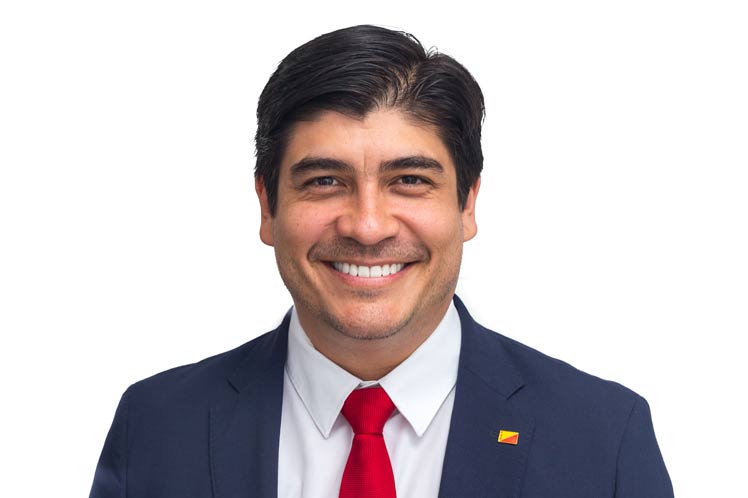
Costa Ricans preferred to give a second chance to the Citizens Action Party (PAC) by electing Carlos Alvarado as the country’s president for the next four years, over Evangelical preacher Fabricio Alvarado.
In elections marked by the polarization of society, Costa Ricans on Sunday voted for the nation’s traditional values and against the ultraconservative discourse of Fabricio, the former candidate from the National Restoration Party.
Fabricio won the first round of general elections thanks to his strong opposition to same-gender marriage, the gender ideology and sex education, as well as his fanatical defense of the Christian concept of family, overcome by the one that prevails today in a more modern, inclusive and tolerant society.
Carlos’ overwhelming victory at the polls contradicted previous surveys, save for the one carried out by the National University that gave him the victory, while other allegedly more recognized firms predicted a tight victory by Fabricio and even an overwhelming win by the preacher.
After the first irreversible results in the elections were announced, the Supreme Electoral Court passed the test with flying colors, because it counted 90.6 percent of 6,612 Voting Boards in two hours and five minutes.
That way, Carlos was proclaimed the president-elect and he will take office on May 8 as the 48th head of State of the 2nd Republic (since 1953).
After 95.58 percent of all 6,612 Voting Boards were counted, Carlos Alvarado had won 1,281,292 valid votes, accounting for 60.74 percent, with participation of 66.99 percent of registered voters and an abstention of 33.01 percent.
Narcos promise not to kill more candidates
Guerrero bishop gets commitment from cartel boss
Narcos in Guerrero have agreed not to kill any more candidates for election after meeting with the bishop of Chilpancingo.
Bishop Salvador Rangel Mendoza, who has previously encouraged dialogue with drug cartels as a means of reducing violence, said he met Friday with a gang leader during a visit to Heliodoro Castillo in the state’s Sierra region.
After raising the issue of the assassination of candidates, he said, the gangster “promised to try to prevent it and allow a free election to take place in which the choice of the people would prevail…”
The cartel insisted on two conditions: that those running for office not give away money in an attempt to buy votes, and that once the election was over the candidates must fulfill all their promises.
“What they ask for is a free, just and secret vote, nothing more,” the bishop declared.
Bishop Rangel had traveled to the town of Pueblo Viejo where criminal elements had cut off electricity and water in an attempt to flush out a number of rivals.
“I explained to them that while some of their enemies might have been there it was also true that there were old people, children and pregnant women, and all of them needed those services,” he said.
Rangel’s intercession succeeded and the gang yielded, reconnecting the utilities.
The bishop refused to identify the criminals with whom he spoke or provide any other information regarding the gang to which they belong.
Relations between Rangel and criminal organizations went awry two months ago when two priests and the relatives of a nun were murdered in two different incidents.
Of the 42 politically-related assassinations in Mexico since September, 12 were in Guerrero. Oaxaca was next with eight.
Source: Milenio (sp), El Universal (sp)
Indigenous people claim rights in Guatemala
Six meetings to be followed by the High Authority Meeting for Ibero-American Indigenous Communities, to be held on April 5th and 6th, began in the city of Antigua Guatemala. More than 250 representatives from indigenous people and governments will draft the Political Declaration to be passed during the 26th Ibero-American Summit of Heads of State and Government, to be held in November also in Antigua Guatemala.
This will be the first time that the indigenous issues and contributions reach directly the policies of the decision-makers in an Action Plan for the implementation of their rights.
The meetings of indigenous youth and women leaders began Monday to foster a regional platform for dialogue with the high authorities outlined as the closing period of a broad meeting of discussions.
A meeting will take place between high authorities and indigenous youth and women on April 3rd and another of the Regional Indigenous Consultative Body and the Intergovernmental Meeting on April 4th.
Many of these initiatives are still dead letters for some indigenous peoples of Latin America and the Caribbean, usually victims of discrimination, marginalization, exclusion, poverty and the inexorable climate change, according to experts.