by Marvin Ramírez
San Francisco Mayor Daniel Lurie’s decision to authorize police to arrest people who use drugs in public and send them to RESET Centers instead of jail is a meaningful shift in policy. It recognizes what many frontline workers, families, and neighbors have been saying for years: addiction is a public health crisis, not just a criminal one. Giving people the option of treatment, detox and medical supervision instead of a jail cell is humane, practical and long overdue.
But if the city is serious about restoring safety and dignity to our neighborhoods, especially in places like 16th Street and Mission and 24th Street and Mission, this policy cannot stop with drug users alone. The deterioration we see every day in these plazas is not driven only by people consuming drugs. It is driven by an informal street economy built around stolen goods — and the buyers who keep that market alive.
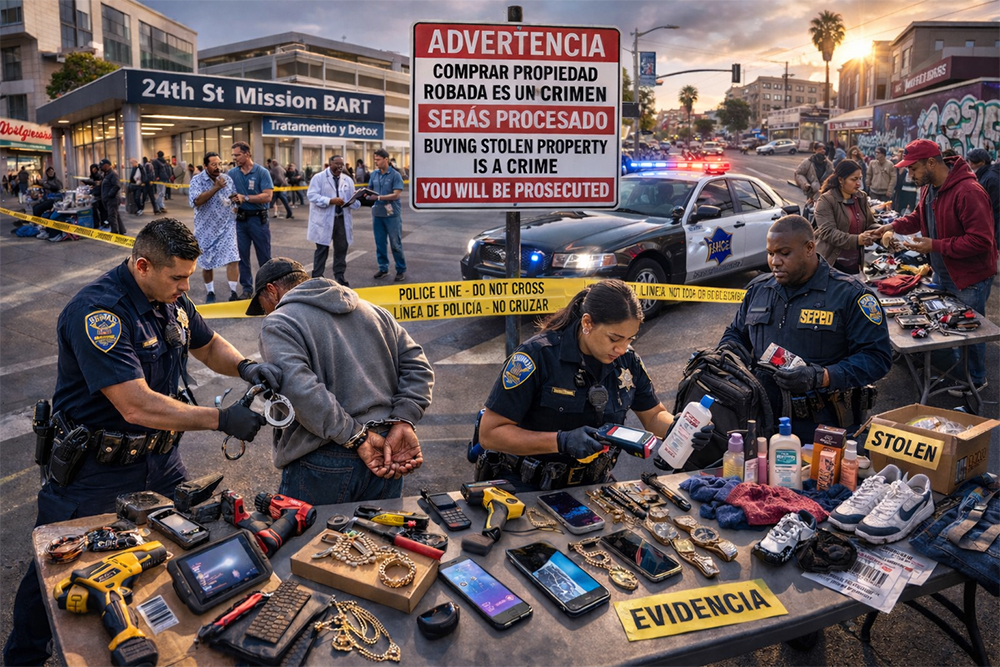
Residents and merchants know the pattern well. The same individuals gather day after day, laying out cosmetics, detergent, toothpaste, liquor and packaged food stolen from nearby stores. Police patrol cars may sit in the plaza during the day, but once officers leave, the market reappears. The sellers change spots. The buyers come back. The cycle continues.
We talk endlessly about “retail theft rings” and “organized shoplifting,” but on the ground, what sustains this economy is not only the thief — it is the customer. Every person who buys stolen merchandise for a discount becomes part of the problem. Yet buyers of stolen goods are rarely targeted with the same urgency as drug users, dealers, or the unhoused. The message, intentional or not, is that buying stolen property is a minor offense, a harmless bargain hunt. It is not. It fuels theft, hurts small businesses, raises prices for honest customers, and keeps people trapped in cycles of crime and addiction.
If we can change the enforcement culture around public drug use, we can change it around fencing stolen goods. The law already makes it illegal to buy stolen property. The problem is not the lack of statutes; it is the lack of consistent enforcement. Buyers in known fencing hotspots should face immediate consequences, just as public drug users will now face arrest and referral to treatment. Without demand, the street market collapses.
There is also a practical, modern solution that the city should explore with major retailers. Most items sold at pharmacies and chain stores today carry barcodes or QR codes that indicate whether they have been scanned and paid for. Technology already exists to flag stolen merchandise. Retailers, in partnership with city agencies, could provide law enforcement with tools to verify items on the spot. If someone is selling or buying goods that clearly have not been purchased, police should be able to confiscate the merchandise immediately and issue citations or make arrests when appropriate. This is not about harassing people for being poor; it is about dismantling a criminal market that preys on both businesses and vulnerable individuals.
Just as important is the power of clear public messaging. The city posts signs warning against public drinking, drug use, and loitering. Why not post large, visible notices in known hotspots: “Buying stolen property is a crime and will be prosecuted”? Clear rules, clearly enforced, change behavior. When people know there are real consequences, many will think twice before participating.
The RESET Centers represent a compassionate attempt to interrupt the downward spiral of addiction. That same philosophy — interrupting destructive cycles — should be applied to the stolen-goods economy that corrodes our neighborhoods. Treatment for drug users is necessary. Accountability for buyers of stolen goods is just as essential. One without the other leaves the system half-repaired.
San Francisco does not have a single problem. It has interconnected ones. Addiction, theft, fencing, and neighborhood decay feed off each other. If we only pull one thread, the fabric continues to unravel. If we pull on both — treatment for users and real consequences for buyers — we finally have a chance to change the daily reality on our streets.