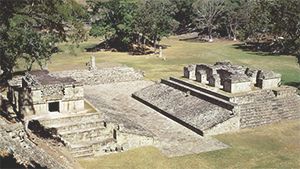
The decline coincides with a steep decline in its population
by the El Reportero wire services
A study of the genomes of seven individuals from the Classic Maya period (250 to 900 AD) from Copán, in what is now western Honduras and near the Guatemalan border, revealed a drastic population reduction about 1,200 years ago.
“The genetic evidence of population decline coincided with the collapse of the civilization,” says the study, published Wednesday in the journal Current Biology. It clarifies that this population reduction does not mean complete extinction.
The document notes that Copán was one of the most important centers of the Classic Maya civilization. While human occupation at the site, with small agricultural settlements, dates back at least to the Early Preclassic period (before 1000 BC), extensive architecture and inscriptions began around 300–400 AD, during the Early Classic period.
A royal dynasty was founded in 426/427 AD, and, according to the study, inscriptions reveal that the first dynastic founder, known as K’inich Yax K’uk’ Mo’, was an outsider who assumed power in 426 AD. “The succession saw a series of 16 rulers over the ancient city and its government,” the document states, noting that Copán prospered as “a political, economic, and ceremonial center, with elite and commoner residential structures identified on the site”; it became an important capital that functioned as a crossroads between Central and South America. Although the population is estimated to have peaked at about 30,000, “the political regime finally collapsed around 820 AD, at the end of the Late Classic period,” the text details.
Lack of outsiders?
The researchers analyzed the DNA of seven individuals buried at Copán, including a possible member of the ruling family and a possible human sacrifice victim found near their tomb.
In the analyses, they found that all the individuals had different maternal lineages; they also found that the population shared a genetic ancestor with other older groups in Belize, with the Maya of Chichén Itzá (Mexico), and with others.
However, they discovered that the Maya population has maintained its genetic line from the Late Archaic to the present day, demonstrating “the continuity of local ancestry in the Maya region.”
“The genetic continuity observed in our study supports the idea that the population was not replaced by another group after the collapse,” they emphasize.