
por Marvin Ramírez
There is a dangerous lie being sold to the public: that farmland is just another commodity, that food production is interchangeable, and that a nation can afford to sacrifice its agricultural base in exchange for corporate development, technological infrastructure, or speculative profit. History shows the opposite. A nation that gives up control of its farmland gives up control of its future. Farmland is not simply real estate; it is strategic infrastructure, as vital to national security as ports, roads, and power grids. Without productive land, a country becomes dependent on imports. Without domestic food production, independence becomes a slogan instead of a reality. Nations that cannot feed themselves are vulnerable to economic coercion, political pressure, and blackmail during times of crisis, conflict, or disruption.
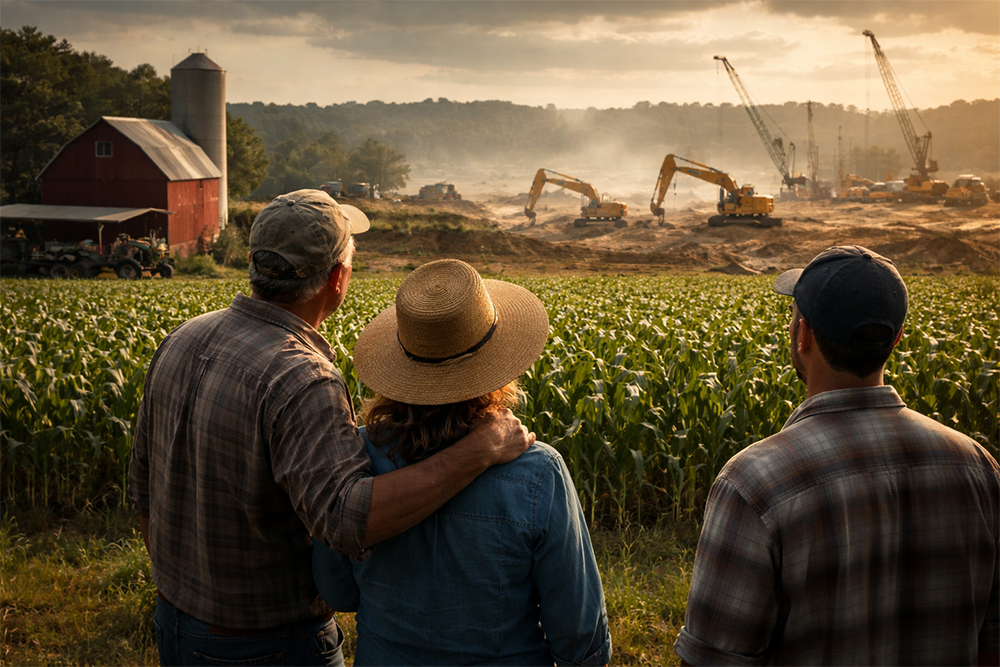
For decades, farmers around the world have been pressured, intimidated, and economically cornered into selling their land. Millions of acres have changed hands, not because families wanted to abandon farming, but because powerful interests made it increasingly difficult to continue. Rising costs, shrinking margins, unfair markets, regulatory burdens, land speculation, and the conversion of farmland into industrial zones, data centers, and energy corridors are dismantling the foundation of food production. The farmer who sees land as heritage and responsibility is forced to negotiate with developers and investors who see only numbers on a spreadsheet. When officials celebrate tax revenue and construction jobs, they rarely calculate the permanent loss of food-producing land and the long-term erosion of rural stability.
This is not merely an economic issue; it is a patriotic one. A country that allows its agricultural base to be dismantled in the name of “development” is choosing short-term profit over long-term survival. Increasingly, corruption and ideological agendas appear to influence these decisions. Natural food production is being devalued while artificial and industrial alternatives are promoted as “the future.” Traditional farming is portrayed as inefficient or environmentally suspect, while lab-produced substitutes and ultra-processed foods are framed as progress. This shift concentrates control of food in the hands of corporations and financial interests, weakening communities and reducing transparency about how food is produced. Food is not just a product; it is power. Those who control food systems hold leverage over populations, prices, and stability.
Environmental challenges are real, but they are being selectively weaponized against small and family farmers while large industrial polluters face far less scrutiny. The claim that eliminating cattle and traditional agriculture will “save the planet” simplifies complex problems and deflects responsibility from corporate actors whose activities carry enormous environmental costs. Responsible stewardship of land, water, and soil is essential, yet stewardship is undermined when farmland is paved over for speculative projects that produce no food at all. Once fertile land is industrialized, it is effectively lost forever. No data center grows wheat. No server farm feeds a community. No corporate campus replaces the resilience of local food systems that can endure supply shocks and global disruptions.
This trend must be confronted with law, not rhetoric. Nations that take themselves seriously should enact strong protections for food-producing land. Agricultural properties should be designated as strategic national assets and shielded from conversion to non-food uses except in rare, compelling circumstances. Incentives should favor regenerative farming, water conservation, and soil restoration, not displacement. Policies that protect farmers from coercive buyouts and eminent domain abuses are essential to preserving food sovereignty. A country that imports its food while exporting its farmland builds a fragile future. Dependence on foreign supplies exposes populations to shortages, price spikes, and political leverage when global trade falters.
True sustainability does not come from replacing farms with concrete and servers. It comes from protecting the land that feeds the people. Farmers are not obstacles to progress; they are guardians of continuity and resilience. Their fields represent independence, memory, and the capacity to endure. If we allow farmland to disappear, we are not just losing acreage; we are surrendering sovereignty, security, and self-reliance. No nation that values its future should accept that bargain.
– With reports.