by Marvin Ramírez
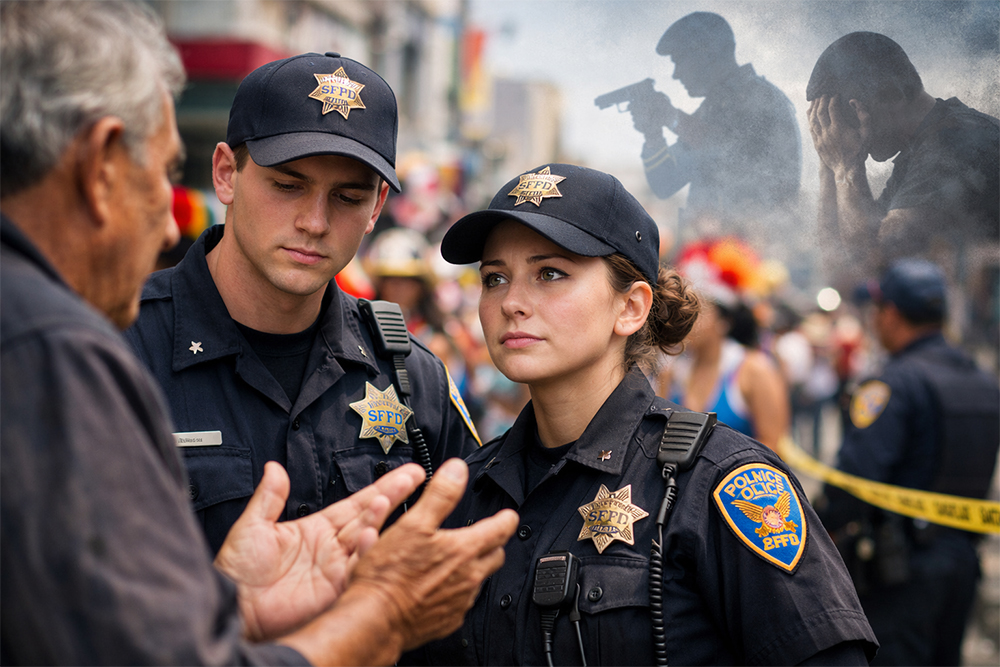
Years ago, during San Francisco Carnaval, I had a brief conversation with two rookie police officers—a young woman and a young man—standing together amid the music, color and joy of the celebration. They were clearly new to the force, energized, proud, and excited to be part of something larger than themselves. I congratulated them. Protecting the community is not a small responsibility. It is an honor, but it is also a burden.
Before walking away, I shared something that has stayed with me ever since. I told the young woman, calmly and respectfully: If you ever have a chance not to kill the person in front of you, don’t shoot to kill. I told her that taking a life—especially when it could have been avoided—stays with you forever. In your heart. In your mind. In the quiet moments when the noise fades and the uniform comes off.
I wasn’t speaking as a tactician or an expert in weapons training. I was speaking as a human being. If a person can be stopped, immobilized, or disarmed without killing them, that option should always matter. We are not on a battlefield. Our cities are not war zones. Police officers are not soldiers confronting an enemy force. They are public servants operating among civilians—neighbors, families, children.
Watching recent events unfold in Minneapolis, that conversation came rushing back to me. I see suffering on all sides. I see the families of those who were killed, shattered and grieving. But I also see the officers involved—people who must now live with the weight of their actions, whether justified or not. A life lost destroys more than one future. It radiates outward, harming families, communities, and the social fabric we all depend on.
I’ve heard for years that police training is modeled, in part, on military doctrine—shoot until the subject stops moving. I don’t know how universal or accurate that claim is, but if it holds any truth, then it deserves urgent re-examination. That philosophy belongs in combat, not community policing. Multiple shots—three, five, six, seven—raise serious moral and practical questions. If one shot can bring a person down, why escalate to lethal certainty?
Accountability matters, but clarity matters too. The officer who fires makes the decision in seconds, based on their perception in that moment. Their supervisor, the police chief, the mayor, even the president—none of them pull the trigger. Blame cannot simply be outsourced up the chain. But training can be reformed. Expectations can be redefined. The goal should be to stop the threat, not to guarantee death.
At the same time, we must speak honestly about protest culture today. When demonstrations turn violent—when officers are attacked, surrounded, or provoked—the risk of death rises dramatically. An officer under physical assault will react as someone fighting for their life. That is reality, not ideology. Peaceful protest is a protected right. Violent confrontation is not. And when violence erupts, everyone loses.
There are also serious questions being raised—by authorities themselves—about whether some protests are being organized, funded, or manipulated to provoke chaos rather than reform. If groups are deliberately escalating conflict to manufacture outrage or destabilize communities, that should concern everyone, regardless of political affiliation. Justice cannot be built on engineered disorder.
What troubles me further is the selective outrage I see on the global stage. Mass protests erupt over certain causes, while the killings of unarmed women in Iran barely register in the streets. I don’t dismiss anyone’s right to protest, but inconsistency reveals agenda. Are some movements less about justice and more about confrontation? Are some protests seeking resolution—or deliberately courting tragedy to fuel a larger narrative?
These are uncomfortable questions, but they must be asked.
We need policing that protects life, including the lives of officers themselves. We need training rooted in restraint, judgment, and humanity. And we need protests that demand accountability without manufacturing violence. If we fail on any of these fronts, the cycle will continue—more deaths, more grief, more division.
I think back to those two young officers at Carnaval. I hope they remember that moment. I hope they never have to carry the weight I warned about. And I hope we, as a society, decide that saving lives—not taking them—must remain the highest priority.